This article was written on December 16th 2025
Unai Emery’s team has been the subject of discussion in the football industry, regarding the sustainability of their goal scoring. They are currently on a 9-game win streak across all competitions and are comfortably ranked 3rd in the Premier League with a +8 goal difference. Based on expected goals (xG) however — the flagship of advanced football metrics — they would rank 15th with a goal difference of -4!
Their xG over-performance stems from their incredible scoring rate on long shots. Within the modern game, more and more emphasis is being placed on high-xG shots and patience around the box. Villa however, have scored 10 long shots already this season, from just 2.21 xG. Rather than shooting less long shots, Villa’s long shot rate has increased over the past three seasons. Morgan Rogers — the individual player with the highest xG over-performance this season — recently admitted that his manager encourages his players to shoot more long shots, rather than less.
Their approach aligns with the findings from my MSc thesis on long-distance shooting and expected goals in the Premier League. I found that since 2019/20 long shot rate has had a significant positive effect on xG of shots from within the six-yard box. This implies that long shots may serve not as isolated, low-value actions, but as mechanisms to stretch defences and improve shot quality closer to goal.
Does this effect apply to Villa as well? That’s too early to tell.
The table below shows the development of their long shot rate and six-yard box shot quality.
Although quality from close-range shots is up by 20% this season compared to last campaign, it’s not as high as in 2023/24. We will have to use league-wide data from the upcoming seasons to make any meaningful conclusions about this relationship in the future, but this might be the start of a new trend: the death of the midrange shot. This phrase will sound familiar for NBA fans. Long shot rate — proportion of 3-point shots — has increased massively in the best global basketball league. The shot that has been replaced has mostly been the midrange shot. The graph below shows the distribution of 2-points attempts across the NBA since 1997.
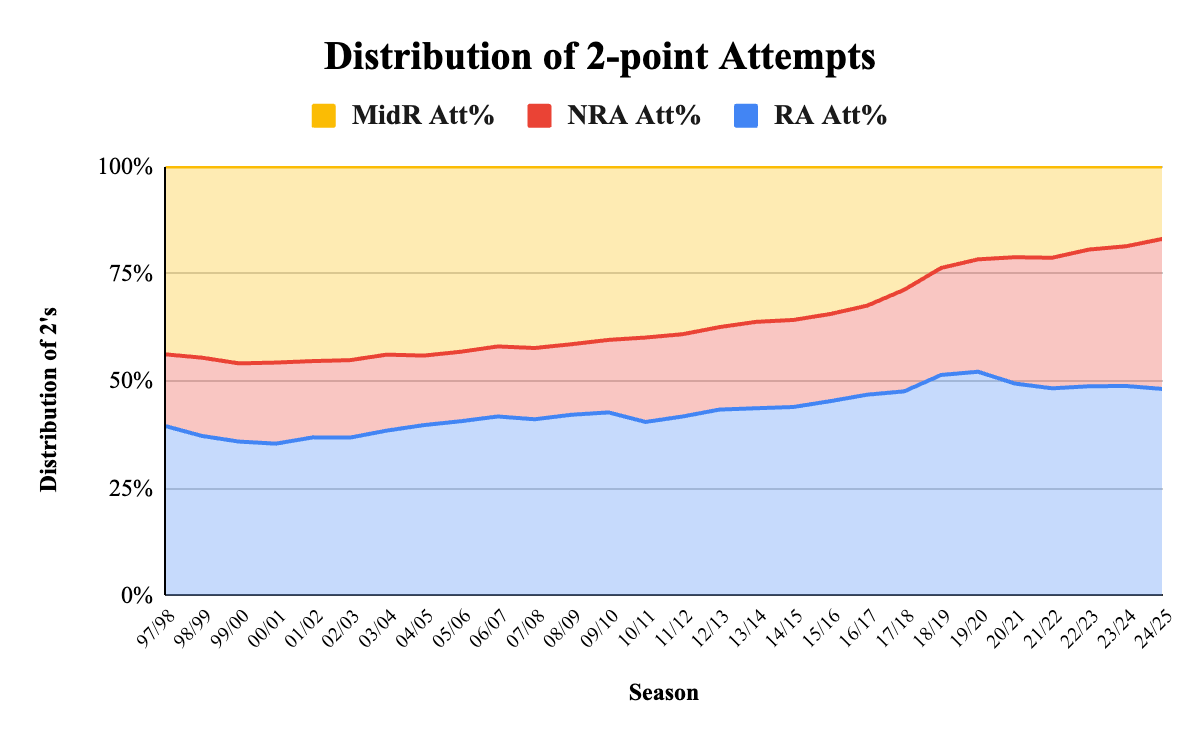
Teams have replaced midrange shots with either:
- Long shots: worth an extra point and stretch the defence and field
- Close-range shots: easier to score
Aston Villa’s data shows the same replacement process over the past three seasons — in which Emery was in charge full-time. The graph below shows the distribution of their shots in that period.
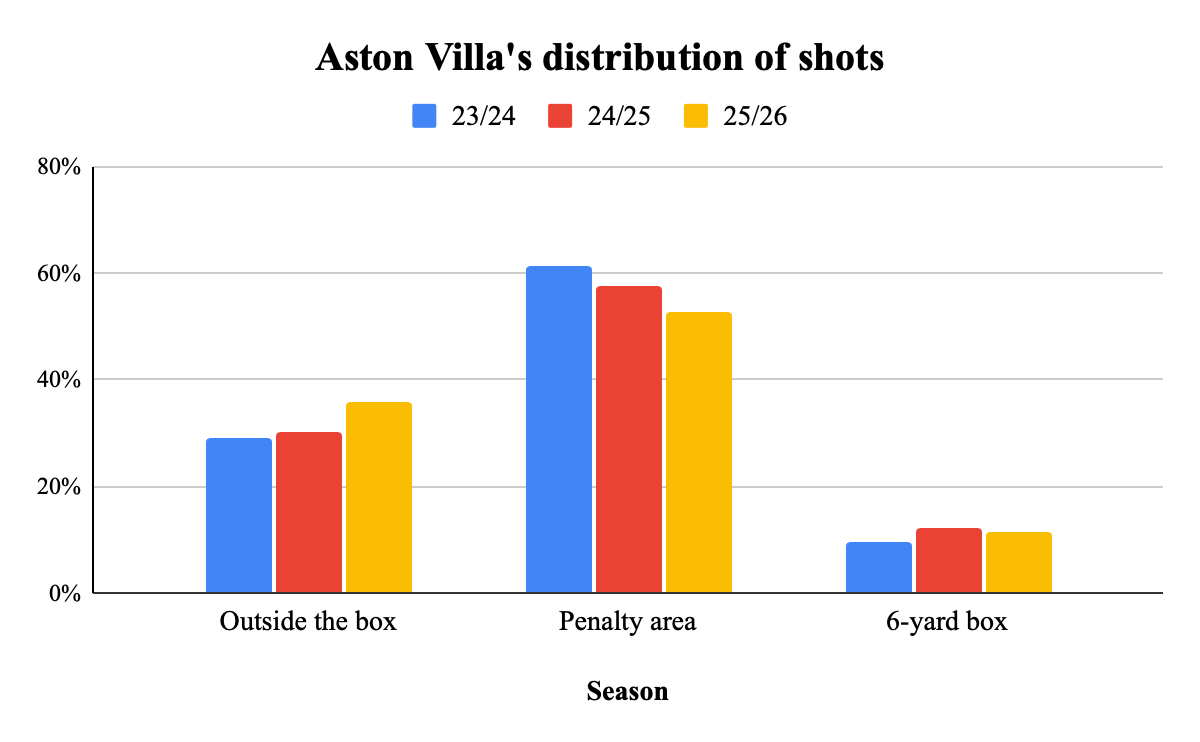
Similarly to the NBA, they have replaced midrange shots — from within the penalty area, but not inside the six-yard box — with long shots. If we combine our prior theory about the relationship between shot quality and long shot rate with this replacement pattern, we can compute the graph below. It shows distribution of total xG per shot zone.
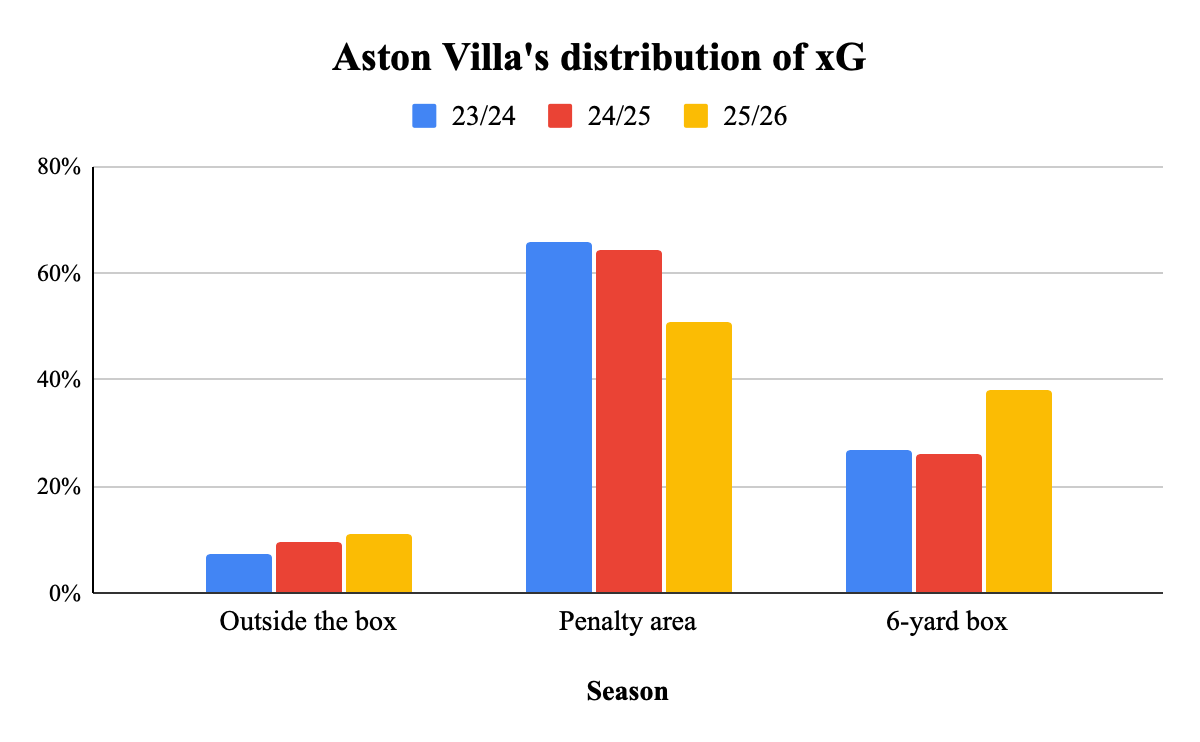
Villa are shifting from heavy midrange to mostly close range xG sourcing. A strategy that ironically aligns with those of data-driven clubs like Brentford. The Bees have the lowest average shot distance across the top 5 European leagues. However, their proportion of xG from within the six-yard box is 30.1%, quite a bit lower than Long Shot FC/Aston Villa’s 38.2%.
Although the massive over-performance on xG is not sustainable, the tactical shift from discarding to embracing long shots might be wise. Every 25-yard screamer by Morgan Rogers will spark more fear into defenders at the edge of the box. How long will opponents continue to clog the penalty box with players rather than step out to defend possible long-distance attempts?
Villa’s data department might have already found more robust evidence on a positive relationship between long shots and scoring chances, similarly to the analysts in the NBA. If so, we will consider the 2025/26 season as the start of a new tactical revolution. Although certainly not the last one.