It comes as little surprise that the years following Arsène Wenger’s departure saw Arsenal caught somewhere between decline and reinvention.
Managers changed. Senior players came and went. But most importantly, what was once identity had given way to uncertainty.
Then, amid the chaos, hope arrived from an unlikely source.
Not a marquee signing, but a teenager from Hale End.
Perhaps that is why Arsenal’s return to the pinnacle of English football feels so inseparable from Bukayo Saka. Not simply because he produced when his club needed him most, but because every phase of the club’s resurgence seemed to pass through him. The academy graduate once tasked to fill in at left-back during a collapsing season became the anchor of Arteta’s attack.
As Arsenal rebuilt, Saka quietly grew into the figure standing at the centre of it all.
One Of Our Own
Joining the club at seven years old, Saka progressed through Arsenal’s academy with a glowing reputation. Coaches and teammates consistently spoke of his humility, maturity and an ever-growing willingness to learn. As Mikel Arteta later remarked, “He is so humble, he wants to learn every day,” a quality that would soon define his rise as much as his performances.
His development through the academy was steady rather than spectacular. Across Arsenal’s U18 and U23 sides, Saka made 57 appearances, registering 7 goals and 12 assists before his rapid ascent into senior football. By the time he made his first-team debut against Vorskla Poltava in November 2018, there was already a growing belief within Hale End that the club possessed something truly special.
Perhaps the story that best encapsulates Saka’s character came after his breakthrough performance against Eintracht Frankfurt in 2019.
At only 18 years old, he announced himself with a goal and two assists in a 3–0 win. He created five chances — the most on the pitch — before signing off with a stunning long-range strike to become Arsenal’s youngest-ever Europa League goalscorer.
Per Mertesacker later recalled: “What tells you everything about Bukayo is what he did with his shirt from that breakthrough game against Frankfurt. The next day he brought it back to us at Hale End and presented it to us as a gift.”
To the public, it was a small gesture. Inside the club, however, it confirmed what many were already beginning to believe: Bukayo Saka was truly one of their own.
Trial By Fire
Following Arsène Wenger’s departure, Arsenal lurched through a period of instability and managerial turnover.
… in comes a certain 18-year-old.
No pressure then.
Initially viewed as a promising winger, Saka quickly developed into something far more important. Injuries to Kieran Tierney and Sead Kolasinac forced Arsenal into a defensive crisis, leaving Freddie Ljungberg and later Mikel Arteta with little choice but to deploy him as a left-sided wing-back despite it being completely unnatural to his game.
Saka commented on this, admitting that his dream had always been to play as a winger. More specifically, “to affect games, score goals and get assists”. However, for the sake of the team, he insisted he was “just doing what the manager asks me to do.”
Where some would struggle, Saka adapted. He learned the defensive responsibilities still key to his game today while remaining Arsenal’s most consistent attacking outlet. During a period of complete disconnect between fans and club, Saka seemed to be a provide a sense of hope. The season’s FA Cup triumph only strengthened that hope. While Pierre-Emerick Aubameyang delivered the defining moments at Wembley, Saka’s contributions to the season felt symbolic of a club beginning to rediscover itself.
The growing affection from supporters was matched by an increasing importance on the pitch — the clearest example coming away to Standard Liège in December 2019. With Arsenal trailing 2–0 and heading towards a damaging defeat, it was Bukayo Saka who sparked the comeback, supplying Alexandre Lacazette with a pinpoint cross before curling home the equaliser himself, helping Arsenal recover and secure top spot in their UEL group.
For a side so desperately searching for direction, it seemed that Hale End had delivered yet again.
Evolution
By 2021, Arsenal were rebuild around former midfielder, Mikel Arteta, where Saka’s game became to evolve. Here, it became clear what began as adaptability soon became something much more significant.
Arsenal were no longer simply shoehorning him in — they were actively building around him.
His rise in output reflected this shift. After registering 14 goal contributions in 2020/21, his numbers climbed progressively as Arsenal re-emerged as title contenders. By 2023/24, he produced 20 goals and 12 assists across all competitions, playing a pivotal role in driving the club back into the Champions League.
Arteta weaponised the right flank as the primary source of threat, a reliance that remains today. The chemistry between Saka, Martin Ødegaard and Ben White became one of the defining features of Arteta’s side, transforming the trio into one of the league’s most effective attacking combinations.
What made their relationship so effective was the way their movements constantly complemented one another. Most notably, Ødegaard would drift into the half-space to combine through quick passing exchanges and underlapping runs, with White’s overlapping run stretching defences, creating the option for a cross into the box or a pass to Saka with space for a one-on-one and a left- footed finish.
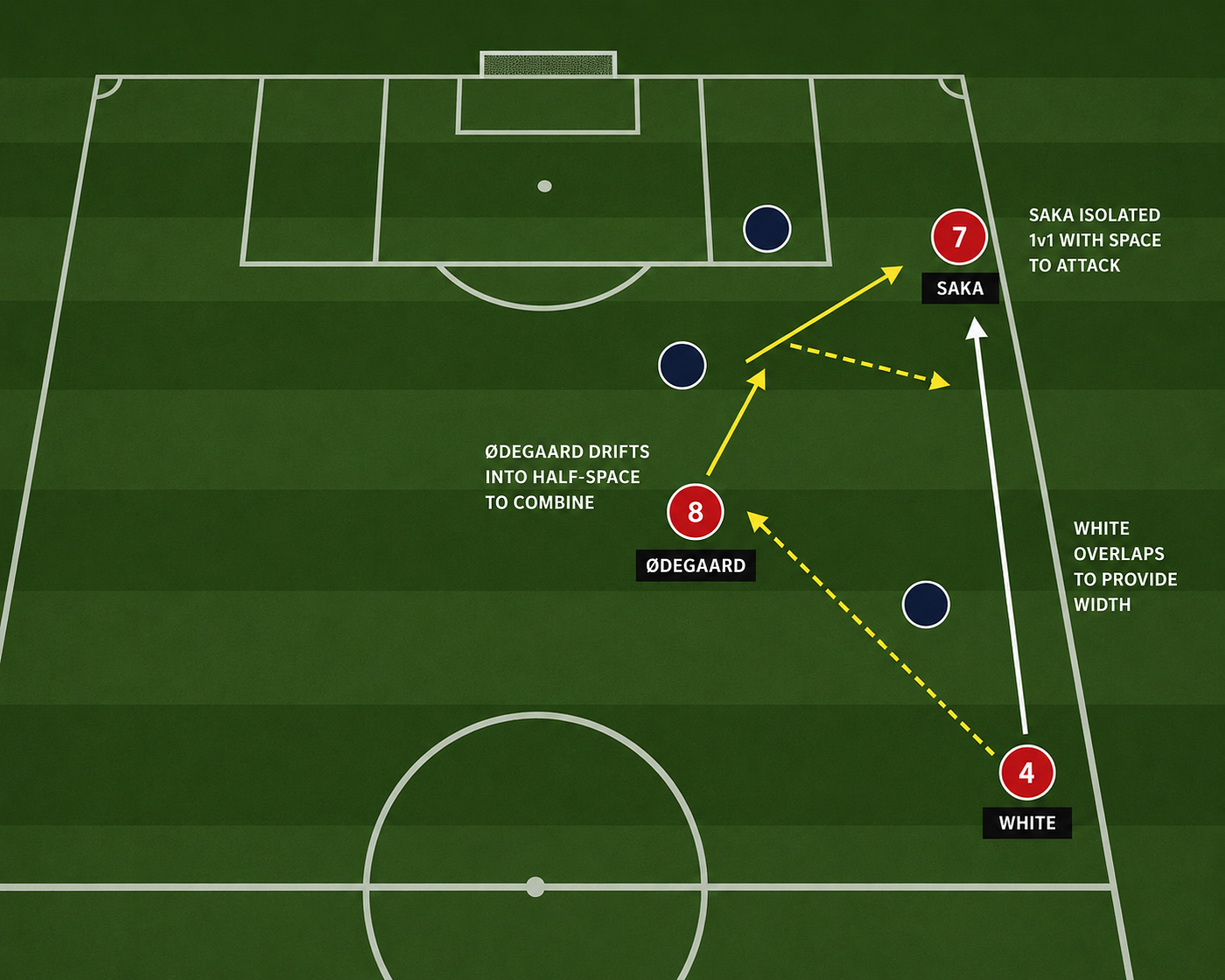
Combinations between Bukayo Saka, Ben White and Martin Odegaard
The result of this was ultimately one of, if not the most synchronised attacking relationships in European football.
Focusing on Saka, as his influence grew, so did opposition plans. Teams began building defensive plans around stopping him, regularly double-marking him and targeting him physically in an attempt to disrupt Arsenal’s rhythm. Ultimately, it was this that accelerated his development, forcing a physical side to his game now central to Arsenal’s game model.
However, In a wider context, it displayed an evolution, capable of the directness under Emery but now press-resistant and capable of controlling matches through composure as much as acceleration.
In doing so, Saka became more than Arsenal’s best player. He became the poster boy for what the club was trying to become:
Fearless. Resilient, but above all else,
elite.
No Light Without Dark
Entering Euro 2020 as a squad option, he forced his way into Gareth Southgate’s England XI. Performances against the Czech Republic, Germany and Denmark in particular cemented his importance heading into the final at Wembley.
At just 19 years old, Saka was selected to take England’s fifth penalty despite never having taken one at senior level prior. However, when his effort was saved by Gianluigi Donnarumma, the immediate aftermath exposed the ugly side of modern football.
Within minutes, Saka, Marcus Rashford and Jadon Sancho became targets of racial abuse across social media.
While the abuse dominated headlines, so did the outpouring of support that followed. Nowhere was that more evident than Saka’s return to London Colney, where he was greeted by walls covered in letters and messages from supporters, transforming one of the darkest moments of his career into a powerful reminder of how truly valued he was.
What was most striking, however, was his own response.
Rather than retreating into bitterness or fear, he carried himself with an all-too-familiar calmness and maturity. In his public statement just days later, Saka directly condemned the abuse before insisting:
“I will not let that moment or the negativity that I’ve received this week break me.”
A defiant response. The real test, however, was always going to come on the pitch.
Nine months later, at Stamford Bridge, it did just that.
With Arsenal awarded a decisive late penalty against Chelsea during the race for a top-four finish, Saka immediately picked up the ball. Without hesitation, he sent Édouard Mendy the wrong way and struck his effort into the bottom right corner.
In many ways, that moment encapsulates Saka far more than the miss ever could.
While pressure never disappeared, nor did responsibility soften, his willingness to shoulder the burden remained relentless.
Full Circle
Goals arrived. The assists followed. And in 2026, after years spent helping drag Arsenal towards the summit, so did the Premier League title.
For many, that would be enough.
Yet what makes Bukayo’s story resonate is not just what he achieved, but the journey behind it. Every major chapter seemed earlier than expected: breaking into a struggling side, carrying responsibility beyond his years, enduring setbacks that may have defined others only to emerge stronger each time.
Perhaps this is why supporters see something of themselves in him.
Not because he is perfect, but because every step of his rise has felt authentic and truly human.
From prospect to Premier League champion, few journeys have felt so intrinsically Arsenal. A title, an FA Cup and two Community Shields may mark his legacy, but they ultimately serve as chapters in a story still being told — one about growth, grit and belonging.
Just a kid from Hale End.
Now a champion.