Jose Mourinho’s FC Porto side remain one of the great stories of football’s modern era, following up their 2003 UEFA Cup win by doing the unthinkable and claiming Champions League glory in 2004.
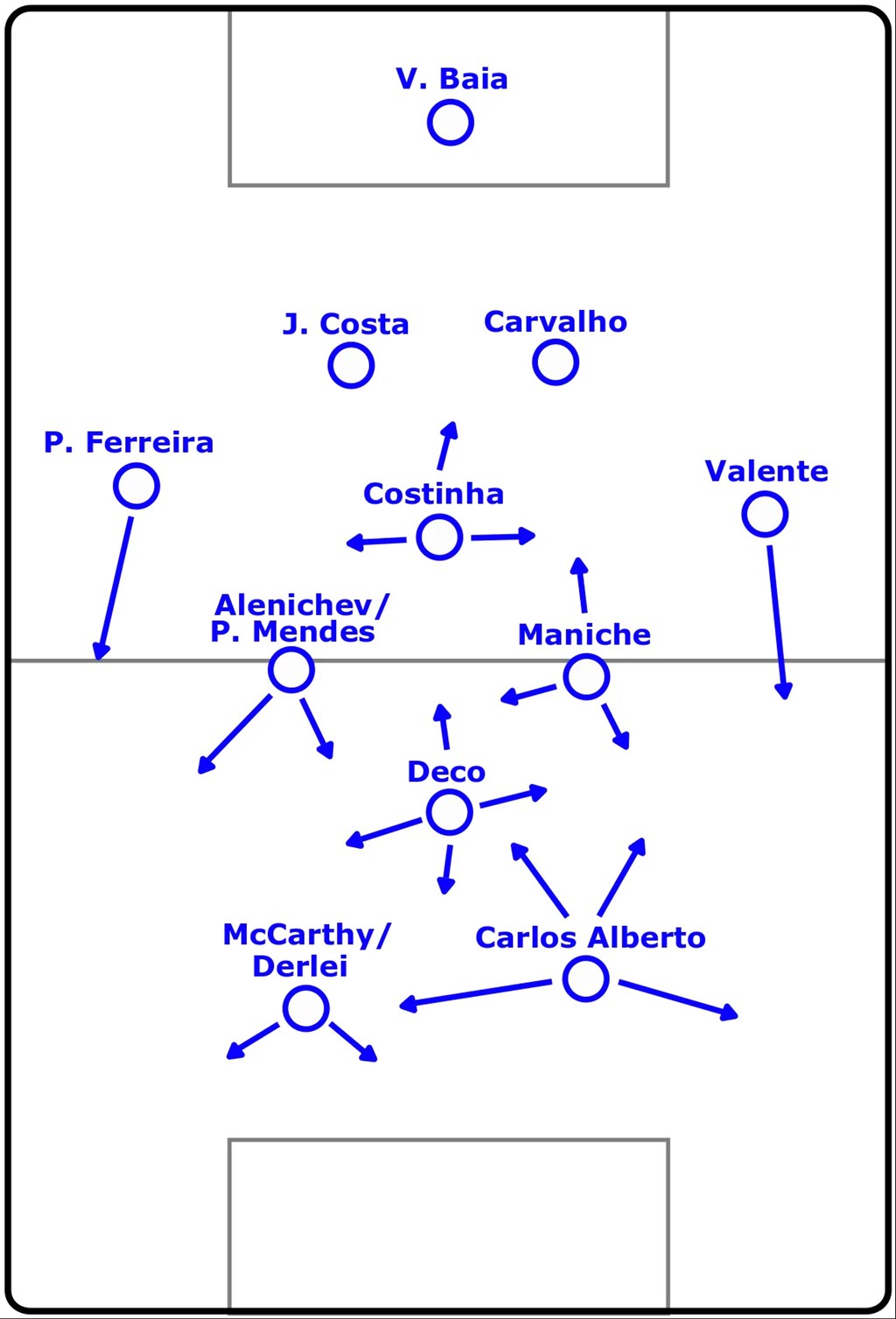
FC Porto’s most commonly used formation and players during the decisive Champions League run in 2004.
Their success was built upon a tactically astute and pragmatic approach on both sides of the ball plus ruthlessness in transitions. Along with defensive grit, they had flair and creativity with players like Carlos Alberto and Deco. This article seeks to analyse the tactical framework that Mourinho used to help this team achieve their crowning glory and further establish his own name as he emerged as one of Europe’s top coaches during the 2000s.
Their success was built upon a tactically astute and pragmatic approach on both sides of the ball plus ruthlessness in transitions. Along with defensive grit, they had flair and creativity with players like Carlos Alberto and Deco. This article seeks to analyse the tactical framework that Mourinho used to help this team achieve their crowning glory and further establish his own name as he emerged as one of Europe’s top coaches during the 2000s.
Defensive diamond
Porto generally started games with a 4-4-2 diamond system. Their defending in this system mostly started from a mid-block, with the naturally strong central presence offered by this system affording a zonal approach in which they could force opponents to go wide or long with their buildup. Porto’s midfield also pressured the ball very well on an individual and group level, including their backwards pressing when beaten. Their industriousness was in many ways the foundation of this team.
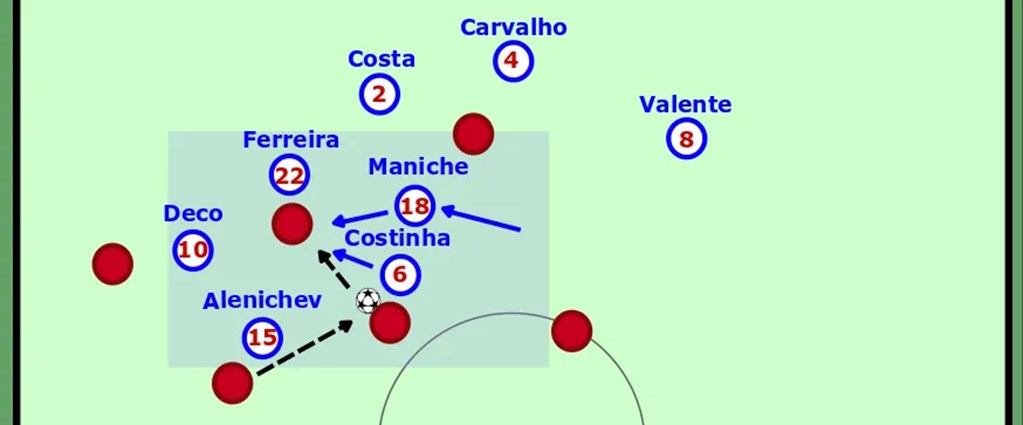
Man Utd try to thread the passes through midfield, Porto’s midfield diamond collapses on the ball and wins it back.
In the early 2000s, direct balls long or out wide were the preference of many teams anyway, with positional ideas less developed than they are nowadays. Therefore, much of Porto’s defensive play revolved around how to deal with direct play, and how to handle getting stretched horizontally when the ball went wide.
A big part of Porto’s success was their ability to win second balls in the centre of the pitch, which was again afforded by their midfield diamond. With Costinha, the two number eights, and Deco able to converge on anything that landed in their midfield, it was difficult for opponents to compete against Porto’s midfield when it came to winning loose balls in their half.
Against wide attacks
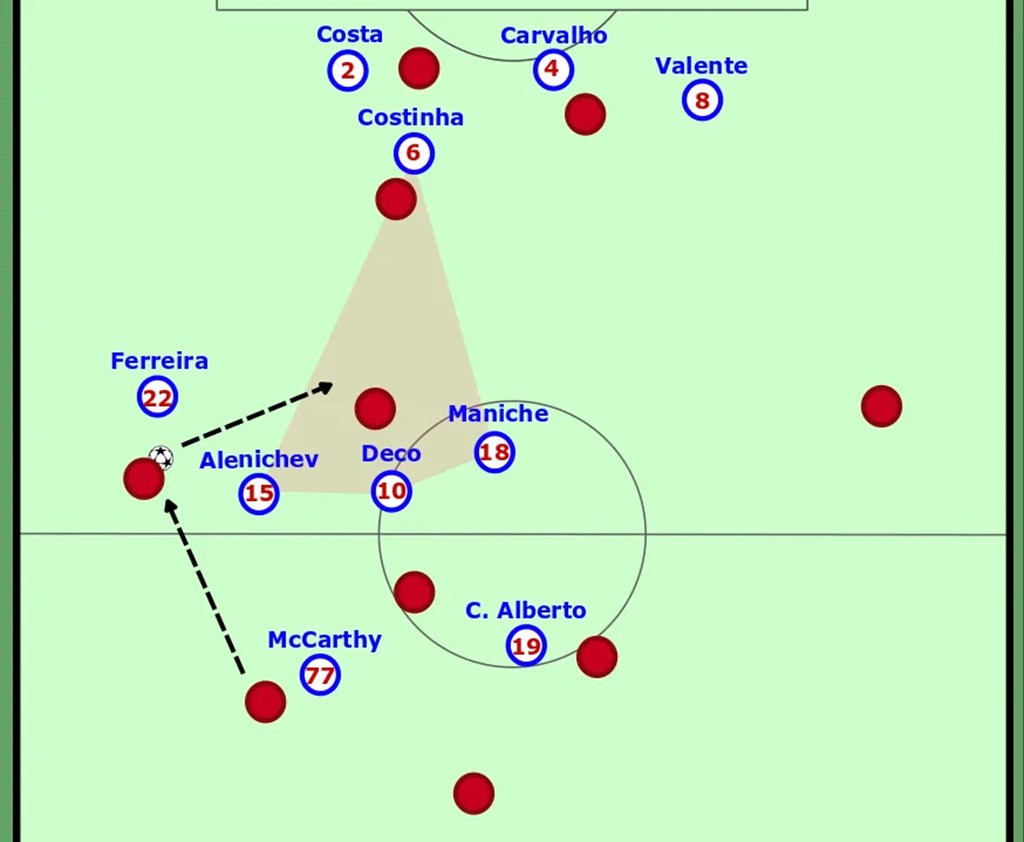
Defending wide attacks presented a new challenge for Porto though. The fullbacks would often step up to pressure opponents when the ball went wide, but this left a large gap between themselves and their centre-backs, who usually remained in fairly conservative positions close to the box, hesitant to get drawn wide.
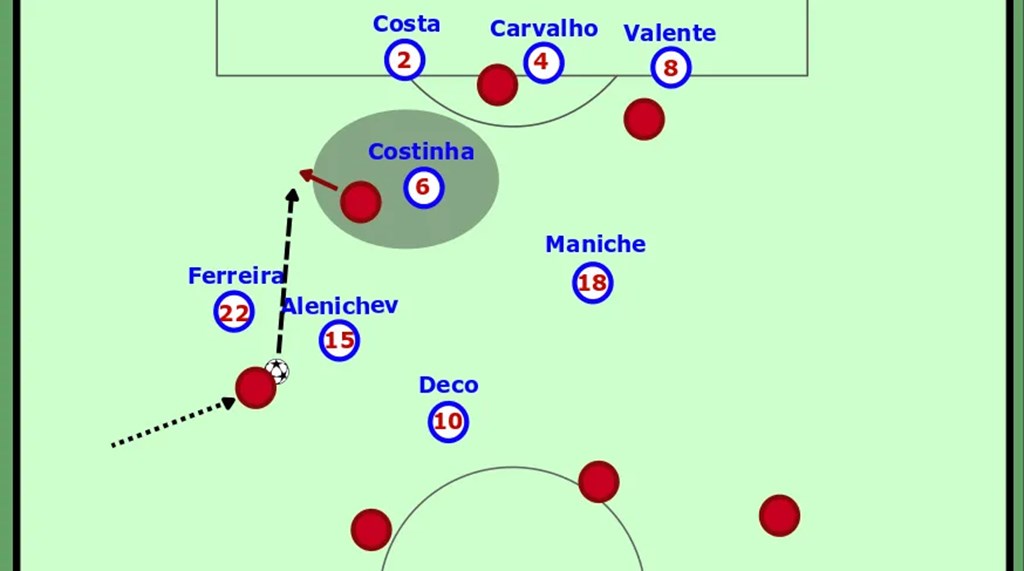
Costinha plays his crucial role in securing the spaces between fullback and centre-back.
Therefore, Costinha often had an important role in helping cover any runs made by opponents into this space. However, as in the case of one of the goals they conceded against Lyon in the quarter final, it was possible for Costinha to become overloaded defensively, in which case the channel between fullback and centre-back could be exploited.
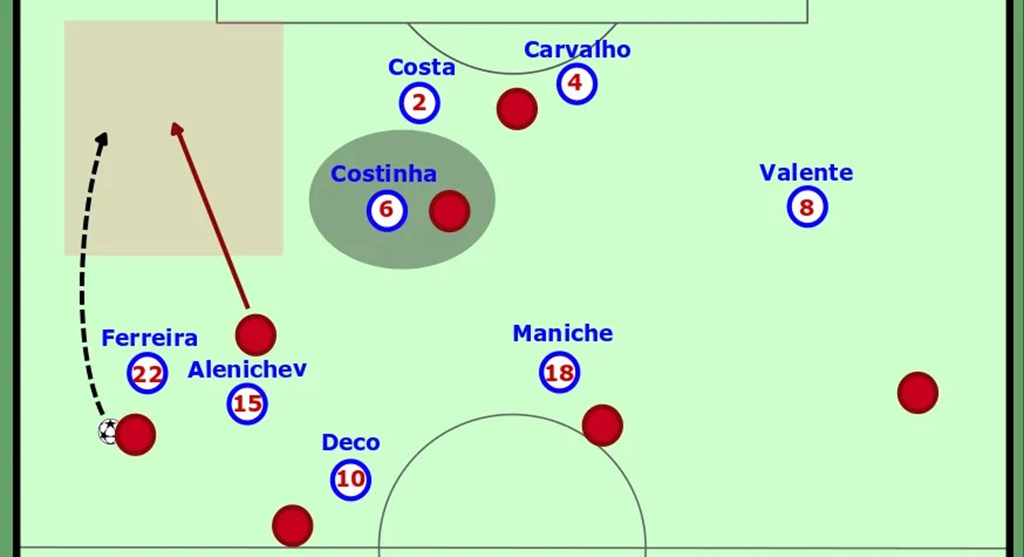
The scene leading to a Lyon goal. Costinha already has an opponent to monitor, making it hard for him to cover the space behind Ferreira. Alenichev loses the runner, who assists the goal.
In general, the demands on Costinha in making this midfield function were quite large, but he handled them well thanks to his tenacity and physical presence. As well as monitoring runs into the fullback-centre-back channel, he also needed to help track midfield runners into the box, and become a third centre-back at times.
Sometimes, Costinha falling so deep could open up spaces in central midfield if this was not coordinated properly with the other three midfielders. If the ball was wide, the ball-near number eight would usually also come out to double up against the ball carrier.
However, this could sometimes extend the gap between the number eight and Costinha, creating a central space that Deco needed to backtrack to cover. He usually succeeded in this, but there were exploitable moments here and there.
Porto’s three more advanced midfielders needed to work hard to stay connected with Costinha, otherwise gaps could appear.
Although we have analysed some occasional issues here, in general, Porto’s defence was solid and well-organized. Costinha swept up plenty of opposition attacks as the number six, and the shuttling number eights for Porto made it hard for opponents to get time and space. If the distances between the midfield three did get stretched, they usually recovered well to get behind the ball and limit the damage.
Defensive line height
A curious and perhaps unexpected feature of Porto’s defensive play that was deployed very occasionally was the offside trap, something that Mourinho’s sides would not necessarily be associated with in the minds of many.
These offside traps seemed to be deployed opportunistically in specific situations where it was clear that the opponent intended to play into depth and the Porto defence could take their chance to push out without too much risk. Alternatively, they’d use it in the rare situations where they were short of defensive cover and the offside trap seemed like a calculated risk to avoid defending while outnumbered.
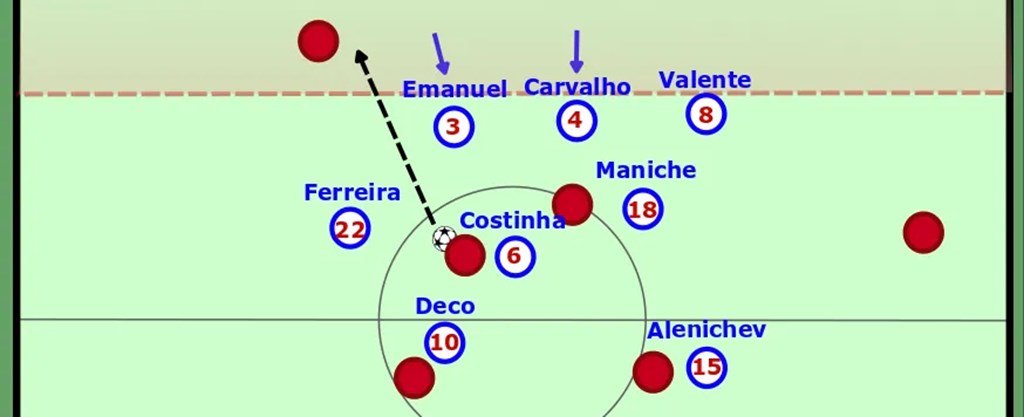
Against United at Old Trafford, the defensive line catches Van Nistelrooy offside.
The offside traps were particularly interesting because Porto’s defensive line was pretty conservative the rest of the time. The centre-backs were keen to drop off a few yards deeper than their fullbacks to give extra coverage for long balls, and as alluded to, tended not to get drawn into wide areas.
Direct attacks
Mourinho’s side are often thought of as a counter-attacking team, and it is true that they were a strong counter-attacking outfit with their strikers able to stretch defences in transition, and the likes of Deco able to feed them running into space.
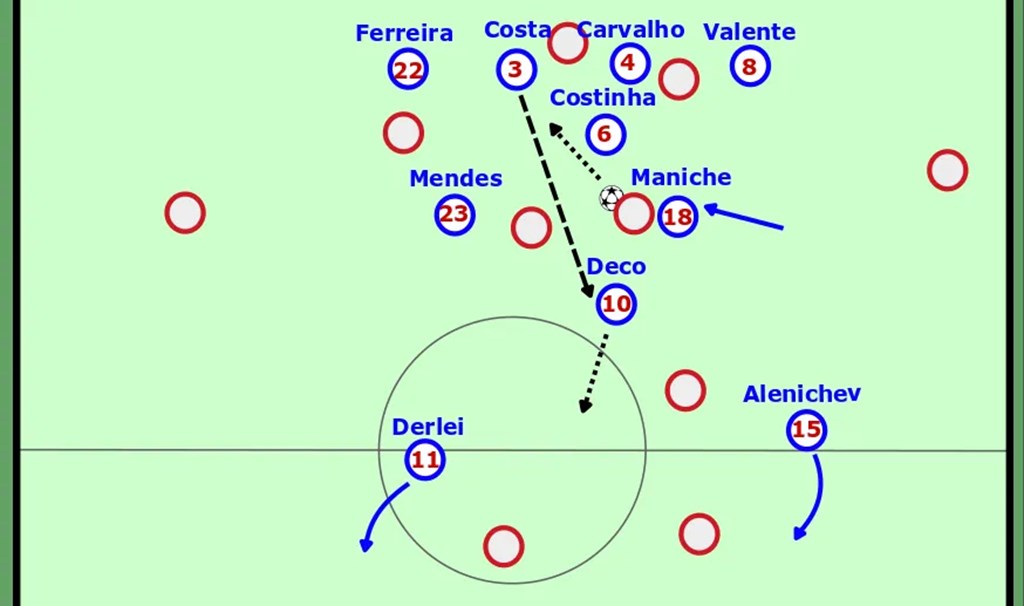
Counter-attack leading to Porto’s second goal in the final against Monaco. They squeeze Monaco centrally to win the ball, then release Deco with Derlei and Alenichev as split strikers either side of him stretching the defence.
Porto were also happy to use longer passes in their own organized progression phases, especially away from home. With the split strikers of their diamond shape, they could often seek the strikers running into the channels or pulling wide onto the fullbacks to avoid the physical duels against big centre-backs. Porto did still use plenty of longer aerial passes into the centre of the opponent’s defence though.
Just as winning second balls was important in Porto’s defensive game, it was also a big part of their attack. Once again, they could benefit from their diamond midfield through a strong central presence in the areas around where the long balls were aimed, and could then counterpress anything that landed in midfield.
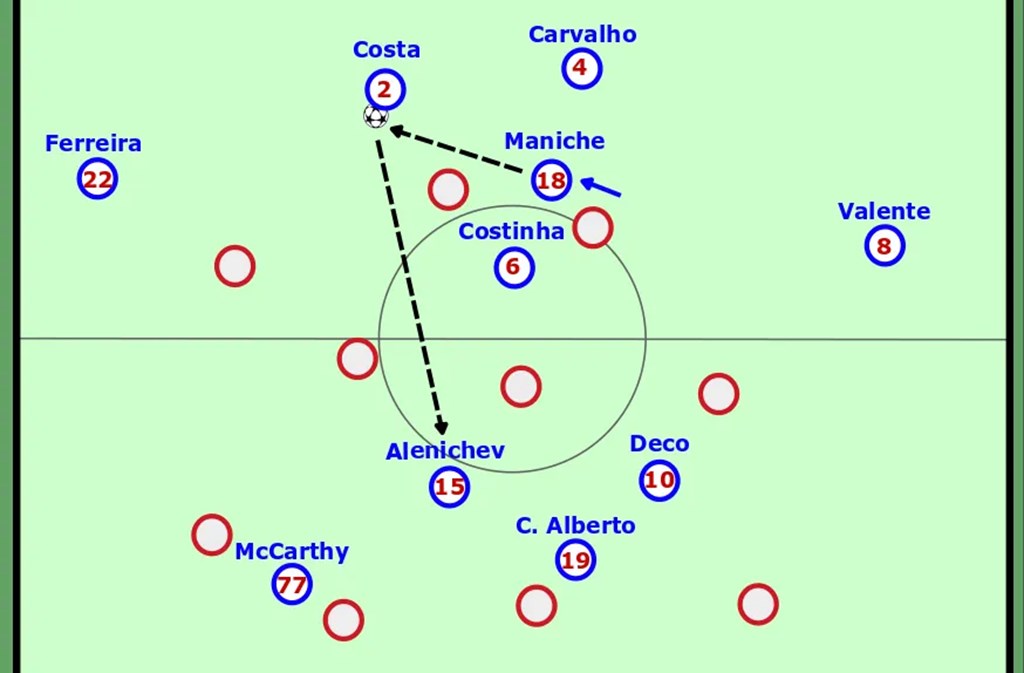
Porto’s occasional midfield transformation, pushing Alenichev forward alongside Deco, with Maniche dropping deeper. Usually they preferred an aerial ball forward, but here Costa finds the line-breaking pass from centre-back.
Sometimes their midfield took on slightly different shapes in buildup as well. One theme was that Maniche, usually the left central midfielder, would often drop into the pivot alongside Costinha to help with circulation, while the right central midfielder, especially when that was Alenichev, would push up between the lines or wider, almost forming what modern coaches could call a box or 2-2 midfield.
Wing play and attackers
A key part of Porto’s attacking success were the fullbacks who were active in providing width. During ball circulation, the fullbacks often started somewhat deep, helping to stabilise the backline. Once the attack was developing, one fullback would attack while the other remained back near the centre-backs, forming a temporary back three.
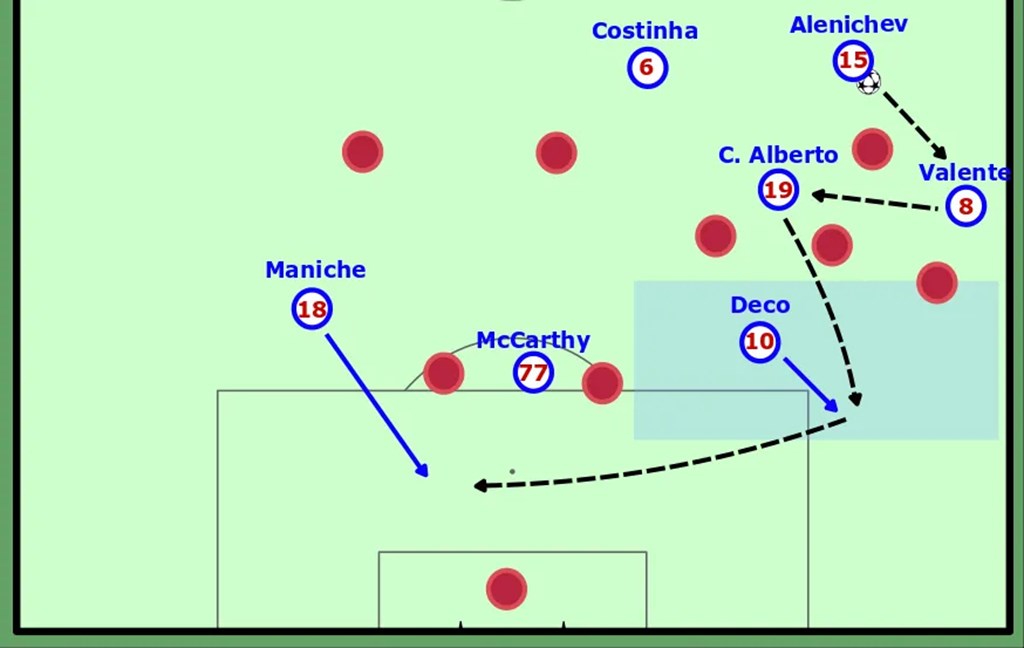
Porto combine with short passes down the left, drawing out Lyon defenders and creating space for Deco, who finds an elegant cross with the outside of the boot to assist midfield engine Maniche arriving at the back post.
The fullbacks were not the only ones involved in wide attacks though. They could also create wide combinations through others drifting wide. For example, Deco liked to drift out to the left halfspace or even left wing to get on the ball with a diagonal orientation, facing the rest of the field. On the right side, Alenichev (or sometimes Mendes when he played there) often drifted wide or made runs into the channel.
Another key player for Porto’s wide attack, and their attacking play in general, was Carlos Alberto. The Brazilian was a tricky dribbler with plenty of flair, but also a powerful tactical actor with his roaming across the pitch. He could come into wide areas to combine and overload with teammates, or drop deeper when receiving the ball.
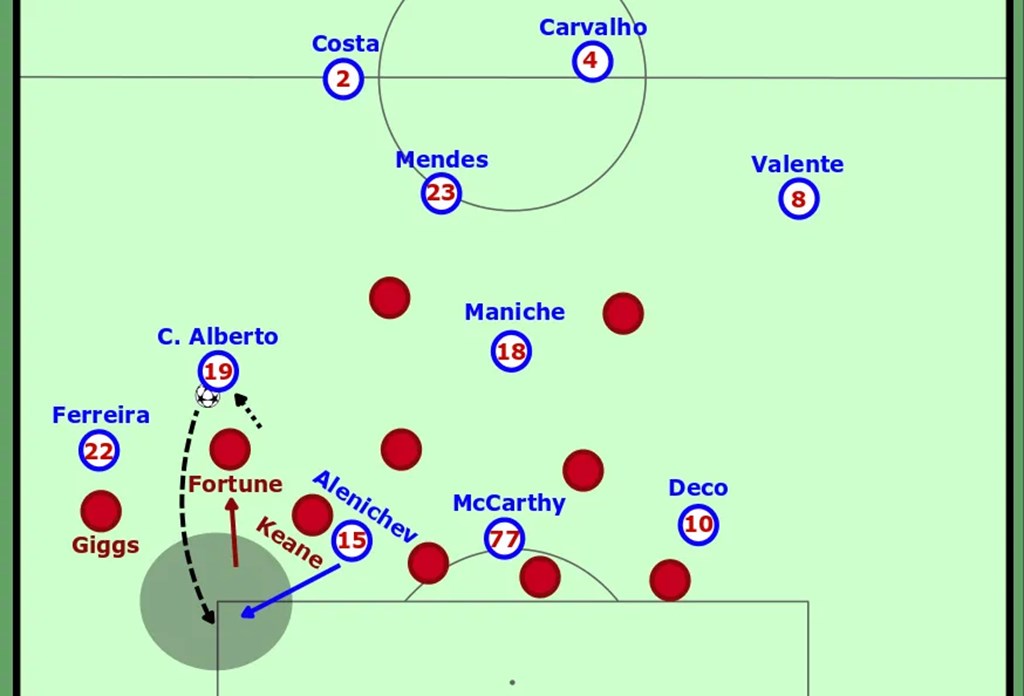
Carlos Alberto drifts across to the right, drags Fortune out of the defence with a short dribble away from goal, then finds Alenichev running into the vacated space. This led to McCarthy’s goal.
He had the habit of drawing opponents towards him with his elusiveness on the ball, which helped create space for others around him, particularly in a time where many teams defended in quite a man-oriented fashion. The Brazilian was something of a master at disorganizing an opposing defence, and watching him leads one to question what could have been if his European football career had been longer.
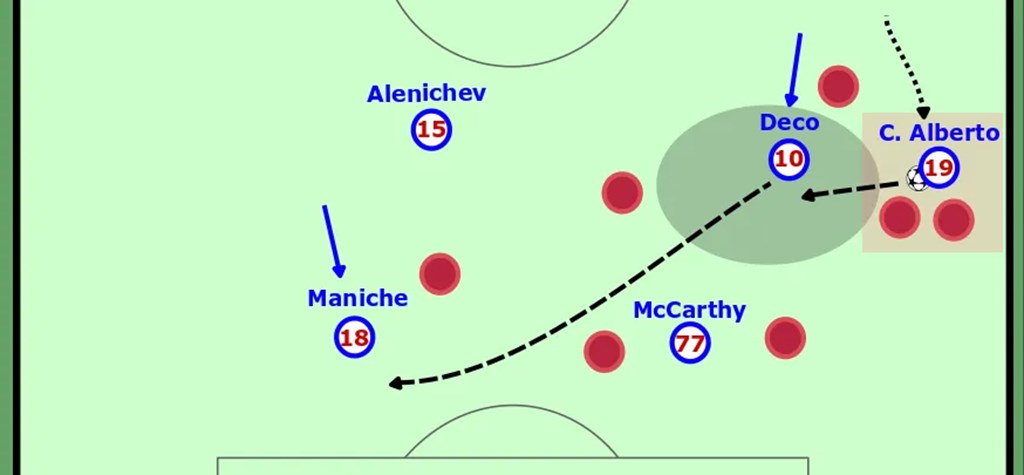
Deco and Carlos Alberto made the attack fun to watch. Here, Carlos Alberto shows his gravity, drawing two defenders with his dribble, creating space for Deco, who then once again finds a nice outside-of-the-boot pass for Maniche’s run from midfield.
Carlos Alberto’s forward partner was usually either Benni McCarthy or Derlei. Either of these would play in a more fixed position than Carlos Alberto, tending to try and stay between the width of the posts and act as a focal point for the team, plus get on the end of crosses that resulted from Porto’s wide attacks.
In-game adaptations
Mourinho would make some in-game tweaks to this team depending on the game situation. When in search of a goal, he would sometimes remove a midfielder and move Carlos Alberto back into the number ten role and Deco back into a number eight position. This often resulted in the aforementioned box midfield, with Deco and Carlos Alberto between the lines.
Jankauskas was a target man that Mourinho liked to bring on to add aerial presence to the attack. This could be deployed either in situations where a goal was needed, or when Mourinho wanted a striker to play long to for defensive purposes, trying to hold the ball up and take the pressure off the rest of the team.
There were a few occasions during the Champions League campaign where Mourinho would switch to a 5-3-2 formation to try and protect a lead. This was usually done with the addition of Pedro Emanuel in place of a striker, with Deco becoming part of a front two with the remaining striker.
This move to a five-man defensive line could help Mourinho to alleviate some of the defensive problems mentioned earlier with the fullback-centre-back distances getting stretched when the ball was in wide areas. Overall, this adaptation made Porto very tough to break down in the final stages of matches with a back five and three industrious midfielders shuttling in front.
A memorable, modern side
FC Porto won the 2004 Champions League with a pragmatic and sound approach, able to deal with second balls and transition situations better than most opponents at the time, helped by Mourinho’s coaching which was also ahead of its time at that point. They also had stability on both sides of the ball, as well as some talented attackers that could make the difference. All of this, combined with one or two moments of good fortune, helped Porto to a memorable Champions League campaign which culminated with their 3-0 win over Monaco in the final.