Whether Gabriel Martinelli remains in North London for years to come or moves on this summer, his legacy at the club already feels secure.
Long before the title celebrations and Champions League nights, he arrived as an unknown teenager from Ituano — though ‘unknown’ may be doing him a slight disservice, having been named the prestigious Campeonato Paulista Countryside Player of the Year.
It comes as no surprise then that few supporters had heard of him, and fewer still imagined the role he would play in Arsenal’s return to the top. Yet as Arsenal rebuilt itself from one of the most turbulent periods in its modern history, he became one of the most pivotal figures of that transformation.
This is the story of how a little-known teenager from Guarulhos became one of the faces of Arsenal’s revival.

Before the Emirates Stadium and Premier League titles, a young Gabriel Martinelli honing his craft in Brazil. Image: The New York Times.
The Long Way Round
Raised in Guarulhos, a working-class city in the São Paulo metropolitan area, football (to no surprise) quickly became the centre of his world. Family played a critical role throughout his journey, with his father, uncles and cousins regularly joining him for games, unknowingly instilling a defiant resilience that would remain evident throughout his career.
“If I didn’t believe in myself, I could never achieve my goals,” he explained. “Without my family, none of this would have happened,” a belief likely fostered during his years as Corinthians, one of Brazil’s biggest clubs.
For years, Martinelli and his father travelled at length across São Paulo so that he could train at the club’s academy, where he learned the standard and mentality expected at one of South America’s footballing powerhouses. However, at only 13 years old, his family faced a difficult situation. Following a job opportunity for his father, they relocated to Itu, forcing a young, hopeful Martinelli to leave behind the environment that seemed to promise a future for his passion.
Understandingly, leaving Corinthians was difficult.
“I just remember being so sad,” he admitted.
However, what seemed to be a setback ultimately became a blessing in disguise. At Ituano, Martinelli matured as both a player and person, becoming the youngest player to represent the club this century and quickly emerged as one of the brightest prospects in the Campeonato Paulista, while his performances earned him the competition’s Young Revelation award and a place in the Team of the Tournament.
Much of Europe remained unaware of his talent, with Arsenal’s scouting network serving as a vital exception. Rather than waiting for him to bloom at a bigger Brazilian club, the Gunners acted decisively, spending only £6 million in July 2019. In doing so, offering him something every young footballer dreams of:
A pathway to the European elite.
He recalled his first days in London as surreal. To elaborate, “When I first walked into the training ground and saw everyone, it took me a bit of time to realise what was happening,” he recalled. “I couldn’t stop smiling.”
Funnily enough, it wouldn’t take long for him to get the North Bank smiling either.
Relentless
Smiling as always, his first real introduction to Arsenal came in September 2019. Making his first competitive start against Nottingham Forest in the League Cup, he scored twice in a landslide 5–0 victory. One goal came from a fearless diving header, the other from a composed finish late in the game. Ultimately, it was only a League Cup tie against lesser opposition. However, his performances raised eyebrows surrounding his potential.
In a game where young players play within themselves in fear of making mistakes, early Martinelli served as a breath of fresh air. Seemingly fearless, he would immediately look determined to impose himself, displaying an unmatched grit and work rate that would become one of his defining characteristics.
This perhaps became most clear to the wider footballing world during Arsenal’s chaotic 5–5 draw with Liverpool that same year.
Away from home, at what is considered one of Europe’s most hostile atmospheres, Martinelli bagged a brace, also converting his penalty in a shootout that Arsenal would narrowly lose. Regardless of the loss, supporters were simply captivated by the teenager. Not simply by his goals, but by his unmatched tenacity. He pressed relentlessly, chased lost causes and approached Anfield with a confidence that belied his age.
A confidence that even had Jürgen Klopp captivated. Reflecting on young Gabi’s performance, the then Liverpool manager labelled the teenager “a talent of the century” before later describing him as “really unbelievable” and “a proper threat.”
In other words, if Anfield was a peek through the door, Stamford Bridge was Martinelli knocking it down entirely.
4 months later, Arsenal travelled to Chelsea with little chance of leaving with points in hand. Perhaps serving as a perfect metaphor of Arsenal’s ‘banter era’, Mikel’s men faced an uphill climb, reduced to ten men following David Luiz’s red card and trailing 1–0.
But of course, young Gabi, relentless as ever, would go on to produce one of the most memorable goals of Arsenal’s modern era.
Collecting the ball deep inside his own half, he blitzed through midfield and past a stumbling N’golo Kanté before calmly finishing beyond Kepa Arrizabalaga. At a time of chaos and uncertainty, his performance reflected the player Arsenal supporters were beginning to adore: direct, fearless, unshakably convinced that he belonged at the highest level. In many ways, he embodied everything Arsenal still believed itself to be, despite years of decline and external doubt.
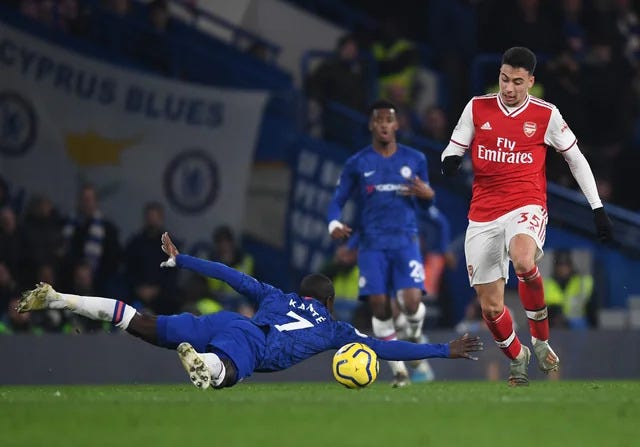
: Direct, fearless and relentless. Martinelli breaks away to score one of the most memorable goals of his early Arsenal career against Chelsea. Photo: Stuart MacFarlane, 2020.
Suspended captain Pierre-Emerick Aubameyang summed this up perfectly, commenting: “Gabi’s gonna be a superstar. Not because of the goal, because of the attitude, energy and mindset.”
Seems a tad ironic in retrospect.
Regardless, for Gooners across the globe, Stamford Bridge seemed the moment Martinelli turned from promising prospect to future star.
The Long Road Back
Just as his rise was gathering momentum it was abruptly brought to a halt. What goes up, after all, must come down.
In June 2020, during a training session following football’s return from the pandemic lockdown, his season was ended by a severe lesion in the cartilage of his left knee. Requiring corrective surgery and six months on the sidelines, the injury resembled the first major setback of Martinelli’s Arsenal career.
Still only 19 years old, he had scored 10 goals in all competitions, appearing to build unstoppable momentum. It is unfortunate then that he suddenly found himself watching from the sidelines.
“It broke me,” he later admitted. “I cried a lot.”
While fans contemplated what Arsenal would lose without him, Martinelli faced a personal battle that’s all too familiar to high-performance athletes: rebuilding both his body and confidence from scratch. Mikel Arteta later reflected on the setback with clear frustration.
“Gabi was in a great place. He was flying.”
However, as they say, every cloud has a silver lining. In Martinelli’s case, the recovery process revealed another side to his character. The injury forced him to slow down, reflect and rebuild, developing a patience that had previously gone unseen. If his rise had showcased his raw talent, his recovery showcased his mentality and dedication.
Eventually, as he worked his way back into the squad, the qualities supporters loved him for remained unchanged. What had evolved, however, was the maturity beneath them.
Sharpening Iron
If Martinelli’s early years were defined by speed, excitement and a ‘never say die’ attitude, Arsenal’s rise under Arteta was initially built on many of the same foundations. Young, fearless and relentlessly aggressive, 2022 saw a team willing to break down walls rather than wait its turn.
Sound familiar?
Throughout his time at Arsenal, Arteta has frequently spoken about the qualities that make Arsenal’s ( the quick one) Brazilian truly unique. As the manager once remarked, “Gabi is pure enthusiasm, energy, belief, charisma and goals. He’s around the training ground and around our training sessions and the energy is different because he goes 100 miles per hour.”
“He’s a player that has decided to compete in every single minute of every game.” “It’s his hunger, his character and desire to be better every single day.”
Yet his development under Arteta extended far beyond mentality alone. The challenge was not motivating intensity, but refining it.
Perhaps the most telling example comes from the boss himself: “You cannot play every action at 100 mph, it is impossible. Gabi is doing much better at that. We have to try to develop that without losing the passion, the energy and this capacity he has to affect the game.”
The arrival of Oleksander Zinchenko and reinvention of Granit Xhaka proved particularly significant in aiding this refinement, transforming Arsenal’s left flank. While Zinchenko inverted into midfield to progress possession, Xhaka remained free to make third-man runs beyond Martinelli, presenting opposition with a crossroads. Double up on Martinelli and leave space elsewhere, or leave him isolated against a single full-back, of whom he usually possessed the pace and technical ability to punish.
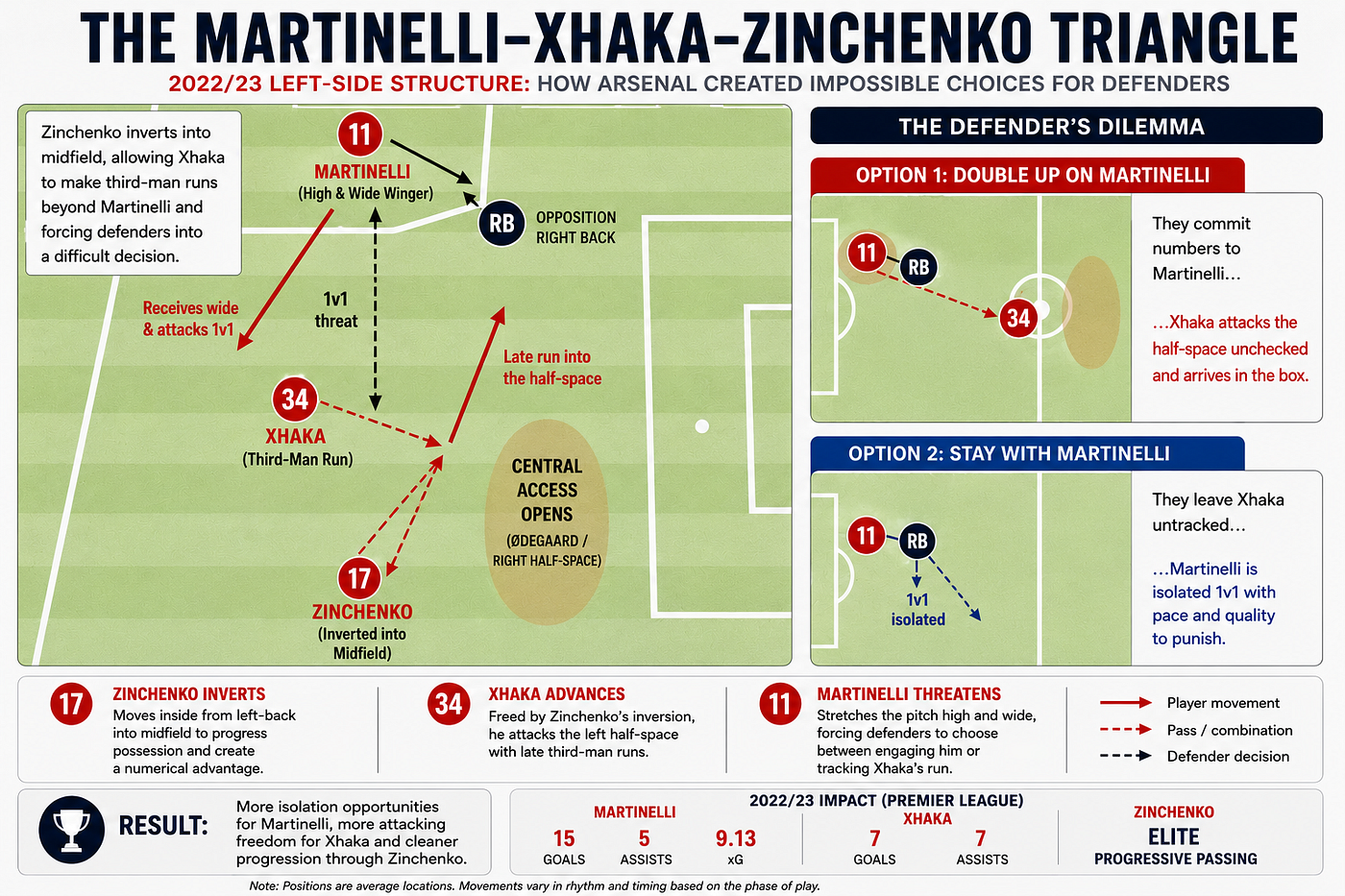
The Martinelli-Xhaka-Zinchenko triangle. Arsenal’s positional rotations on the left flank repeatedly created isolation opportunities for Martinelli and space for Xhaka’s late third-man runs.
The impact of this is clearly reflected through the numbers. During Arsenal’s 2022/23 title challenge, Martinelli produced a career-best 15 Premier League goals 5 and assists, comfortably outperforming his expected tally of 9.13. (Premier League) Fitting then, a season later, following Xhaka’s departure and with Zinchenko’s recurring injuries, his league goals fell to just six. Ultimately, highlighting just how important Arsenal’s left flank had become in unlocking the Brazilian’s potential.
Together with Bukayo Saka, he became one of the faces of a new generation, helping drag the club away from the stagnation of the past and towards something far more ambitious. Their partnership offered balance across both flanks: Saka’s composure and creativity complementing Martinelli’s directness and aggression, forcing opponents to contend with two entirely different attacking profiles.
Proof Of Concept
Every prospect’s rise eventually reaches a point where potential gives way to certainty.
For Martinelli, that moment arrived against Liverpool in October 2022.
Three years earlier, Anfield introduced him to the football world. Now, at the Emirates, he looked ready to dominate.
Perhaps no performance illustrated this clearer than Arsenal’s 3–2 victory over Liverpool in October 2022.
Less than a minute in, Martinelli burst beyond Trent Alexander-Arnold before calmly finishing past Alisson Becker. Throughout, he tormented Liverpool’s defence, combining lung-busting running with an increasingly polished finish. It seemed that the player who had first caught Jürgen Klopp’s attention 3 years ago was now tormenting a Liverpool side that had spent the previous 5 years competing at the summit of English and European football.
Across the full 90, Martinelli registered a goal, an assist, three successful dribbles and two key passes, earning a 9/10 rating from Sky Sports. It was not simply an energetic display of youthful promise; it was a complete performance. One that revealed a player capable of deciding outcomes at the highest level.
By full- time, Arsenal had secured three points in a title race they would ultimately fall short on. However, for Martinelli-and Arsenal as a whole- the season served as an important stage of growth, providing the experience and belief that would underpin the years that followed.
The teenager who had once intrigued Klopp at Anfield was now one of the faces of Arteta’s Arsenal.
“He’s become exactly the player I expected,” the Liverpool manager reflected.
It seemed only fitting, then, that Arsenal would soon hand him the iconic №11, putting what was once a little known teenager from Brazil at the center of it all.
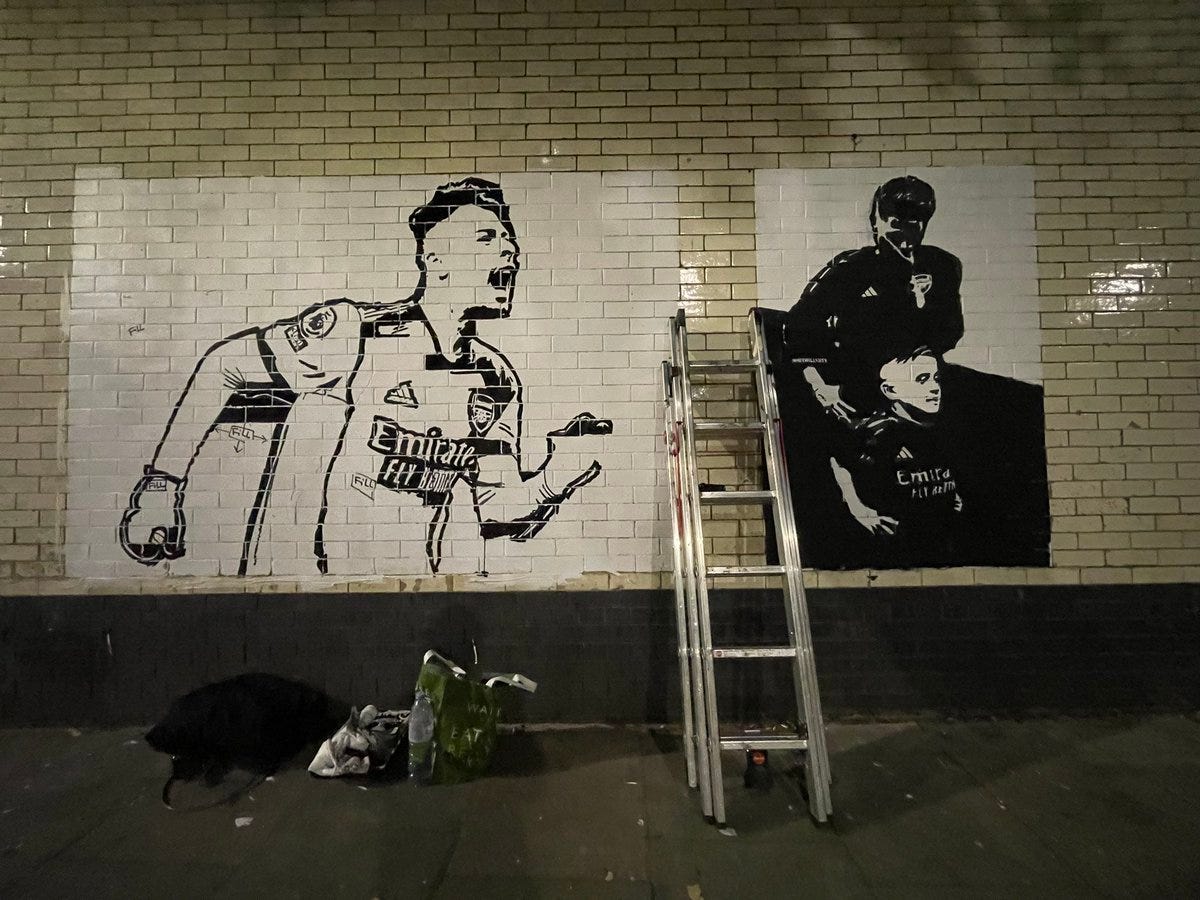
Immortalised in paint throughout North London, Martinelli’s place in Arsenal’s modern story is already secure. Artwork by TheNorthBanksy.
One of Our Own
By the time Arsenal sat immortalised in silver, champions of England once again, Martinelli had lived every stage of the journey. He arrived before Arteta, before the great rebuild, a time where title celebrations seemed some sort of lunacy. Years later, here he is, watching it all work out.
“I got here before Arteta, so it’s something that I always talk about. Winning this title today is something that I’ve been dreaming of.”
For Martinelli, the moment represented far more than silverware alone. It was the culmination of a journey that began in Guarulhos, passed through Ituano and through relentless hard work and will, eventually reached the pinnacle of English football.
Even in the euphoric chaos of victory, his thoughts immediately turned elsewhere.
“It means a lot to everyone in the football club. Everyone deserves this moment and everyone is part of it.”
A response that perfectly encapsulates his character.
Arsenal supporters embraced Martinelli because of the way he played the game. Goals, assists and Xg aside, every sprint, every press and challenge carried the same unmistakable message: he cared. A sentiment made all the more powerful during a period where Arsenal initially seemed to embody the antithesis.
Some players arrive at a club. Others become part of it. For Martinelli, he’s certainly the latter.
Immortalised in paint throughout North London, it’s never been clearer…
GM11. He’s one of our own.
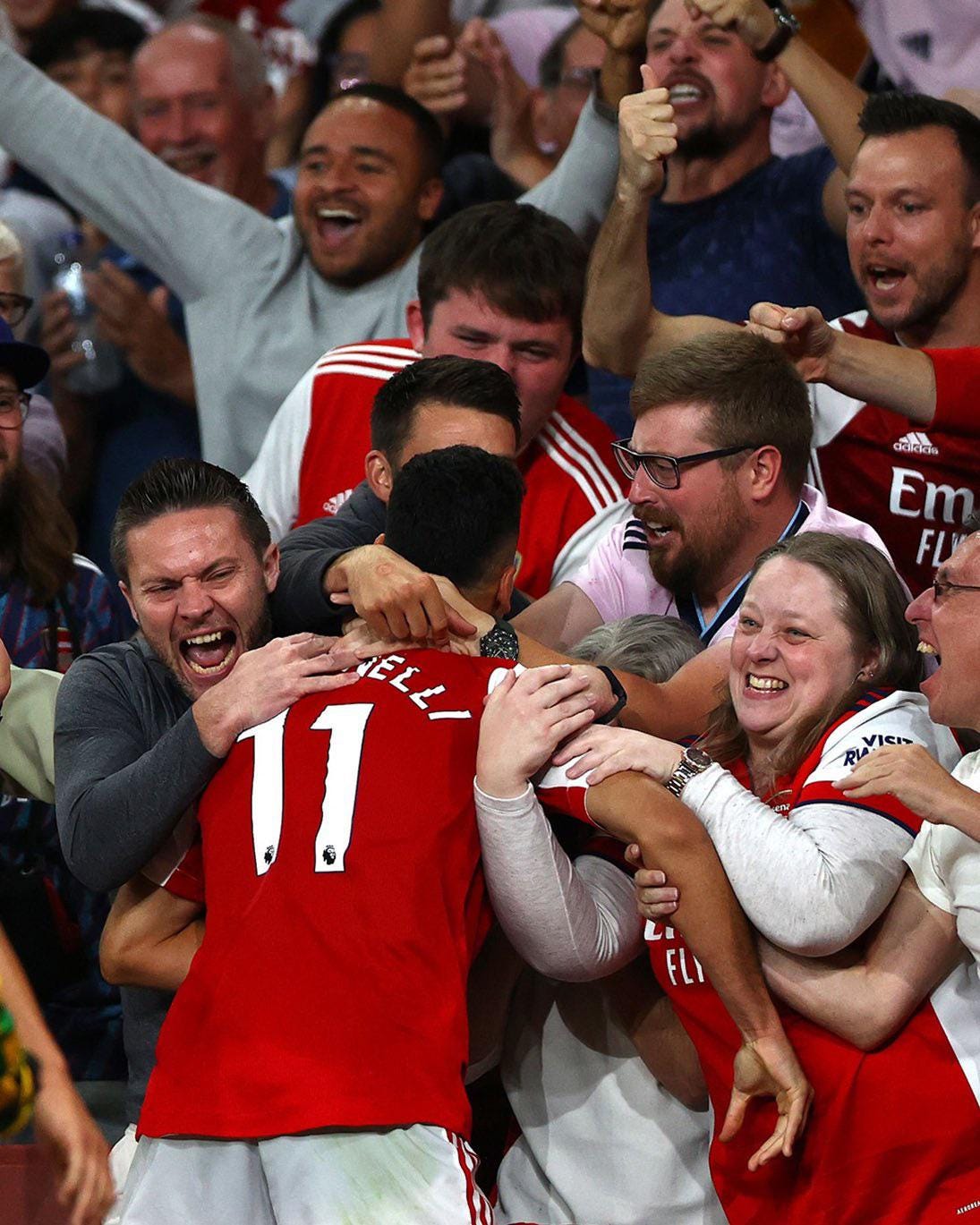
Embraced by the Emirates faithful, Martinelli’s bond with Arsenal supporters became one of the defining aspects of his journey in North London. Source: Reddit.